
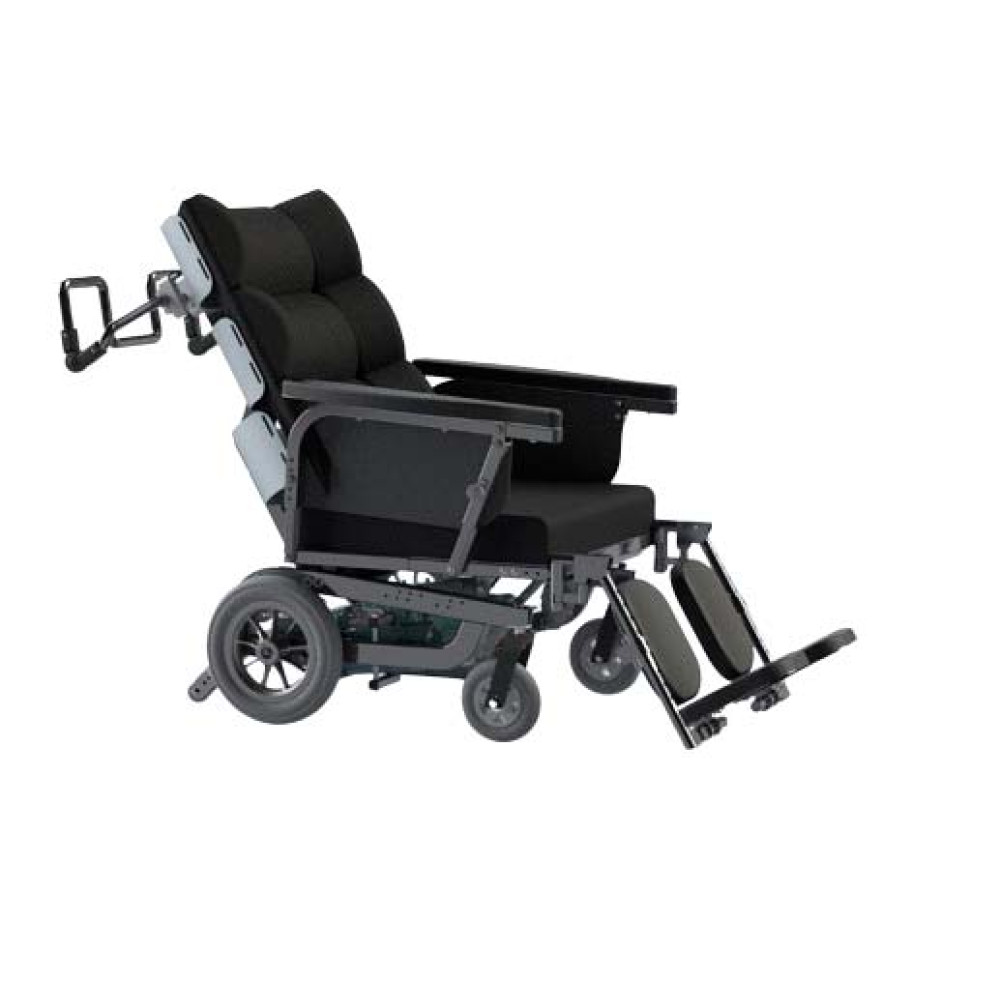
Cruise Power bariatric comfort wheelchair
- Availability: 1-3 weeks
-
0.00€
- Ex Tax: 0.00€
The most powerful wheelchair on the market for use in the rehabilitation of bariatric users.
Equipped with electric propulsion and tilt and recline functions. For bariatric users in need of a comfort wheelchair with a pressure-relieving seat.
Cruise Power bariatric comfort wheelchair is crash tested. Read more in the text below.
Ideal use for
Bariatric users up to 325 kg in care centres and hospitals, in home care and in private homes.
Cruise Power
Cruise Power is a bariatric comfort wheelchair with electric propulsion.
The design of the Cruise Power comfort wheelchair addresses the daily challenges faced by bariatric users, aiming to enhance their quality of life. Evaluated by Danish bariatric users, the development of the Cruise Power comfort wheelchair has benefitted from valuable suggestions for improvement.
Operating a Cruise Power comfort wheelchair provides the freedom to move. Users are able to transition from a state of bedridden dependence to newfound autonomy. Furthermore, the Cruise Power embodies high degrees of safety, benefiting both the user and the caregiver.
Electric tilt and recline
Negative tilt aids the independent user in safely getting in and out of the wheelchair. Negative tilt means that the front of the seat cushion is lowered. This reduces the access height which, in turn, makes getting in and out easier for the independent user. The function negative tilt is activated using the joystick.
Recline provides the apple-shaped user with supported and comfortable seating. When the back of the wheelchair is tilted backwards, the pelvis of the user is automatically opened. This provides improved respiration for apple-shaped users. The recline function (90-120°) is controlled using the same joystick as for the electric tilt function (-4-13°).
Travel
The control box for travel is installed underneath the seat plate. The wheelchair can reach a speed of up to 6 km/h. The maximum range is approx. 9 km at full load. The wheelchair can traverse edges and doorsteps of up to 50 mm. Cruise Power is also built to be able to drive up and down hills and ramps of a 10° incline. For the user, it means freedom to get around both indoor and outdoor.
The seat cushion
The base of the seat cushion consists of hard foam. The core of the seat cushion consists of memory foam specially selected for the target group. The top consists of soft foam. The seat cushion is upholstered with a flame retardant incontinence cover.
Armrests
Extra-long armrests (615 mm) ensure stability and a good grip when the user moves from a standing to a sitting position or vice versa. The armrests can swivel back, making it easier to move the user from e.g. the chair to the bed. It also means that the wheelchair can be moved close to the edge of a table, allowing the user to participate in social activities at e.g. a table.
The armrests are padded for extra comfort. They are also “cup-shaped” thus reducing the risk of pressure ulcers. Each armrest can withstand a maximum load of up to 200 kg.
Push bar
The push bar is flexible and adjustable, using a click system. Major adjustments can be made with tools. The bar has several grip points, depending on whether the chair is to be pushed or manoeuvred.
Leg rests
The legrests of the wheelchair are an option. The legrests each support up to 200 kg and are adjustable in both height and position. They also have a swivel function that allows easier access to and from the wheelchair.
The angle of the footplates, the height/angle of the legrest and the angle of the calf plates can be adjusted without tools. The flexibility of the legrests means that the user’s legs can always be supported. This benefits, inter alia, users with a significant tissue on their inner thighs. The legrests may be removed without the use of tolls without affecting stability.
Construction
The Cruise Power is constructed from type-S355, high-tensile steel. The rectangular steel profiles of the chair form the basis for its base frame. The base frame is made up of two mirror-inverted parts (a right and a left part) connected by a centre module. This structure allows the sides to be reused if the width needs changing. The seat frame of the wheelchair consists of 30x30x2 mm high-tensile steel profiles. In addition, the seat frame has a 2 mm steel seat plate attached to it, which helps to distribute the pressure in the best possible way.
The back of the wheelchair consists of a high-tensile steel profile. The profile is positioned centrally on the back of the wheelchair. The angle of the profile means that the back supports both apple-shaped and the pear-shaped users. Three back plates are mounted on the profile. The back plates are curved to hug and support the user from buttocks to neck.
Pear-shaped users with voluminous backsides are ensured good back support, as the design of the “spine” of the wheelchair and its lower back plate provide space for the backside.The upper two back plates ensure that apple-shaped users enjoy stable and comfortable back support. The wheelchair neck support is an option. The wheelchair is supplied with a universal neck support bracket, allowing for the installation of different types of neck support.
The brake of the Cruise Power is integrated into the motor. This means that when the joystick is disengaged, the wheelchair stops.
The Cruise Power has three actuators. Two seat actuators and a back actuator. The two seat actuators control the tilt function. The seat actuators are installed under the seat. The back actuator controls the recline function. The back actuator is also installed under the seat.
Back cushion
The back cushion is divided into nine modules, which are sewn together into one large cushion. All nine modules consist of two parts. A firm foam layer and layer with a mixture of polystyrene (Krøyer) beads and latex foam.
The foam layer faces the back of the wheelchair while the bead and foam layer is the one sat on by the user. The bead and foam mixture is modular and helps to increase the comfort of the wheelchair and its pressure relieving effect.
The contents of in each cushion module can be adjusted. This means that, according to professional assessment, the therapist or care staff can add or remove Krøyer beads and latex foam. If necessary, a wedge cushion can also be inserted in one or more modules. The pillow contents are adjusted via the nine zippers located on the back of the cushion.
The modular cushion follows the shape of the back plates and, thus, ensures correct support regardless of user body shape and needs. The modular cushion can be finely adjusted using a patented FitGo system known from ski boots and work shoes. The FitGo system is located on the back plates.
Crash tested in accordance with the ISO 7176-19 standard
The Cruise Power comfort wheelchair is crash tested which means it can be used in Community Transport vehicles or adapted vehicles for transporting wheelchair users without them being removed from the wheelchair itself. The wheelchair will need to be secured to the vehicle by a Transit Tie Down System (accessory).
Safe transport is a key element in a wheelchair user’s ability to access medical facilities as well as to improve quality of life, by being able to enjoy day trips out and holidays.
Wheelchairs that have been manufactured and suitably tested for secure use within a vehicle are marked clearly on the wheelchair with anchor symbols featured on the frame of the wheelchair. The icon is most commonly displayed on the front frame of the wheelchair. Public transport, taxis and ambulance attendants will look out for either the hook symbols on the back of the chair, or the crash tested sticker.
Specifications
| Max. user weight, kg | 325 |
| Risc class | 1 |
| Basic UDI DI | 5740000100023N6 |
| Crash tested | Yes, in accordance with the ISO 7176-19 standard |
| Wheelchair class | A |
| Expected product service life | Minimum 7 years |
| Seat depth | 480-600 mm, in 30 mm intervals |
| Back angle | 90°- 120°, continuously variable |
| Seat angle | -4-13° |
| Height of back rest | 613 mm |
| Max. length Excl. foot rests Incl. foot rests Length measured from push bar in normal position to the front edge of the seat |
Approx 1246 mm Approx 1773 mm |
| Seat width | 550-800 mm, at 50 mm intervals. 100 mm between 700 and 800 mm |
| Max. total width | 676-926 mm |
| Max. total height | 1115 mm |
| Max. weight of wheelchair | 120 kg |
| Max. height of curb which the wheelchair can safely traverse | 50 mm |
| Max. downhill inclination | 10% |
| Max. uphill inclination | 10% |
| Max. sideways inclination | 10% |
| Massive tyres | Nylon tyres with PU core |
| Speed at electric propulsion | 6 km/h |
| Theoretical continuous distance (fully loaded) | Approx. 9 km |
| Theoretical manoeuvring distance (fully loaded) | 3. 9 km |
| Frame tubing (material) | type-S355, high-tensile steel |
| Arm rests swing away | Yes |
| Leg rests height-adjustable | Yes |
| Removable leg rests | Yes |
| Neck support | Yes |
| Seat cushion filling | CMHR 50250 (base), Visco 45060 (core), CMHR 4038 (top), flame-retardant |
| Back cushion filling | CM 2740 (base), Cut latex og EPS-kugler (fronten), flammehæmmende |
| Back and seat cushion | Covered in incontinence cover (G469 black), flame-retardant |
| Arm rest cushion | Foam (CMHR4250 and RF5060), cover durable imitation leather (Temskay Leather), flame-retardant |
| Cushion in foot and lower leg support | Foam (CMHR4038), cover durable imitation leather (Temskay Leather), flame-retardant |
| Push bar | type-S355, High-tensile steel |
| Wheel forks | Aluminium |
| Foot rest tubing | Steel |
| Foot plate | S355 High-tensile steel |
| Turning radius (Pivot) | Approx. 100-120 cm |
| Foldable | No |
| Battery | Lithium 24V 49 Ah |
| Three actuators | LINAK LA23 |
| Control box | Curitss-Wright R-net PM120 |
| Joystick | R-net JSM-LCD |
| Electric wheelchair, including components | DS/EN 12184: 2014, saskaņā ar ISO 7176 |
| Risk assessment | EN/ISO 14971: 2012 |
| IP-code | IPX6 |
| General requirements and test methods | EN 12182: 2012 |